
Bedford County Criminal Court Cases
The Court of Common Pleas of Bedford County, Pennsylvania's 57th Judicial District, hears felony and misdemeanor matters after the preliminary stage. The Clerk of Courts keeps the official Common Pleas criminal file on the first floor of the Bedford County Courthouse, 200 South Juliana Street, Bedford. The criminal division can be reached at 814-623-4833 during the county's published general hours, 8:30 a.m. to 4:30 p.m.
Four magisterial district courts receive complaints, conduct preliminary arraignments, set bail when appropriate, hold preliminary hearings, and decide summary matters. They keep their own lower-court records. A docket beginning with an MJ office number is not the same file as the later CP-05 Common Pleas docket. When charges are held for court, use the new CP-05 number for pleas, motions, trial activity, disposition, sentence, and financial entries.
Four Bedford Courts, One Central Court
Bedford County has five practical court-record access points. The Common Pleas clerk is at the courthouse. District 57-3-01 is at 1563 Market Street in Schellsburg, 814-733-4375; 57-3-02 is at 120 West John Street in Bedford, 814-623-6918; 57-3-03 is at 124 Hitchens Road in Defiance, 814-390-6061; and 57-3-04 is at 119 Spring Lane in Everett, 814-652-2523. Calling with the citation or docket number helps staff locate the right file.
Countywide preliminary hearings are consolidated on Wednesdays at 57-3-00 Central Court in the courthouse. Hearings start at 9 a.m. and continue until complete. The Wednesday-only number is 814-624-2254. This local system can produce an MDJ docket, a Central Court event, and then a Common Pleas docket for one prosecution. Searchers should not stop after finding only the first number.
The county list of magisterial district judges shows those offices and the Central Court procedure.
The county listing helps match a lower-court docket to its actual records counter before a call or visit.
Searching Bedford County Case Records
The free Unified Judicial System Case Search covers Pennsylvania courts and can be filtered to Bedford County. JavaScript and cookies must be enabled. Recent entries can lag, and public results omit juvenile, expunged, sealed, and limited-access cases. PAeDocket offers the same general public docket scheme through the judiciary's mobile app.
- Select Court of Common Pleas or Magisterial District Court and choose Bedford County or the 57th Judicial District.
- Use the full docket number when known. Otherwise search a participant name and narrow the results with available identifiers.
- Match the OTN, arresting agency, filing date, birth date when available, or incident number before treating a result as the right person.
- Open the docket sheet and read entries in date order, then compare charge and disposition rows.
- Ask the Clerk of Courts or the relevant MDJ for official copies, certification, older papers, or documents that are not posted.
| UJS field | Use | Bedford County tip |
|---|---|---|
| Docket number | Direct search | CP-05 and MJ-573xx formats identify court level |
| Participant name | Broad name search | Confirm identity with other fields |
| OTN | Links an arrest cycle | Useful across MDJ and Common Pleas records |
| County or district | Limits location | Select Bedford or the 57th Judicial District |
| Incident or complaint | Agency reference | Can connect a police event to the docket |
| Case status or dates | Narrows results | Allow for recent filing delay |
The captured UJS interface illustrates the statewide search rather than a Bedford-owned database.
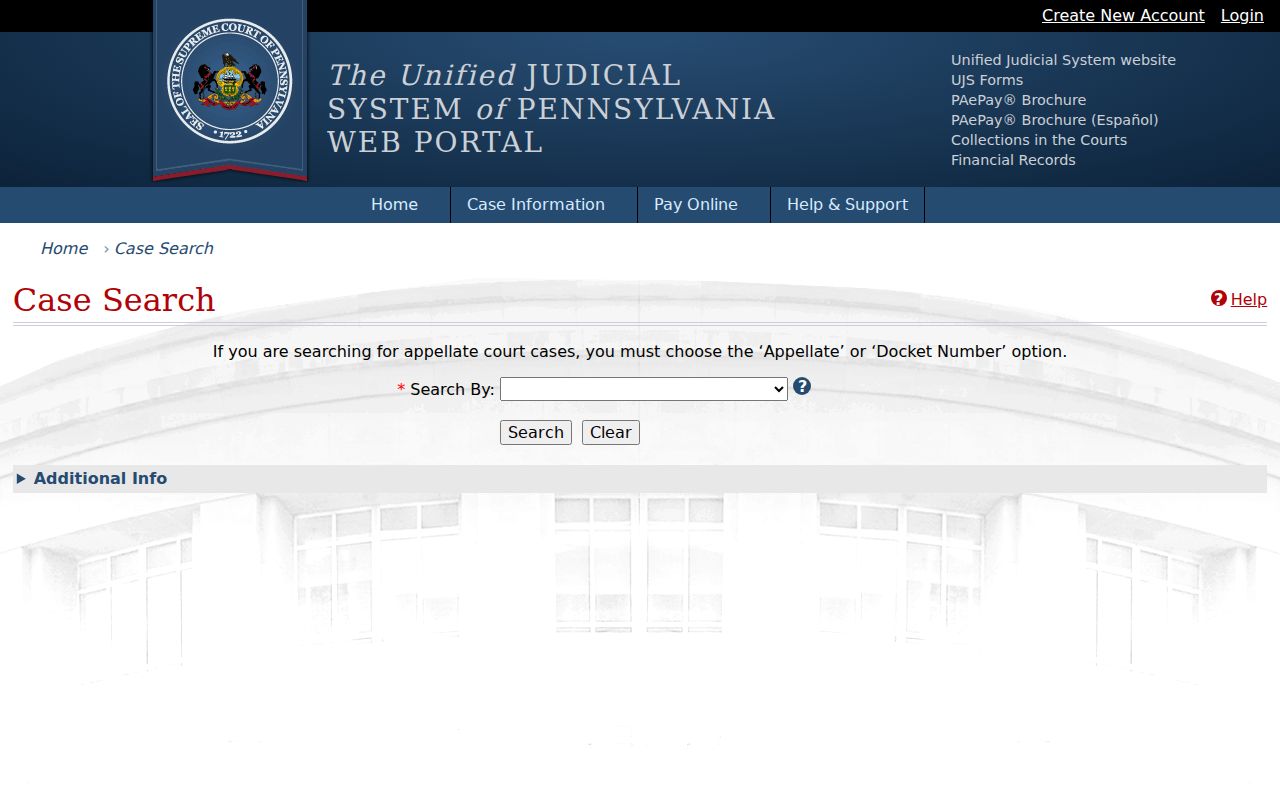
Filtering the statewide form carefully is vital because identical names can appear in several counties and court levels.
Bedford County Clerk Criminal Desk
The online docket is an index and event history, not a complete set of every filed paper. Contact the Clerk of Courts for the authoritative Common Pleas file, a certified copy, an older case, or a document image that UJS does not offer. Sheri Lowery is the elected Prothonotary and Clerk of Courts, and Brian Way is identified as First Deputy of the Criminal Division in the research. The public counter is on the courthouse first floor.
The official clerk page is the source for its current contact details.
This is the proper office for Common Pleas copies, while an MDJ office remains the source for its own preliminary-stage paper record.
Inside a Bedford County Case File
A Bedford County docket should be read as a sequence, not as a single charge label. Confirm the court and docket number first. Then compare the original charge rows with their final disposition rows, review bail changes, and follow entries through the sentence order and financial section. An open balance does not prove current custody, and a zero balance does not prove dismissal.
| Case and court | CP-05 or an MJ docket, court office, caption, filing date, and status |
|---|---|
| Identifiers | OTN, complaint or incident number, and arresting agency |
| Charging papers | Complaint at MDJ level and information after transfer to Common Pleas |
| Charges | Sequence, statute, description, grade, offense date, and disposition |
| Bail and events | Bail type and changes, hearings, arraignment, pleas, trial, and orders |
| Outcome | Disposition, confinement, probation, restitution, and public conditions |
| Financial entries | Assessments, payments, adjustments, and balance |
A docket sheet can show that a charge was withdrawn, dismissed, amended, resolved through a plea, tried, or sentenced. It does not replace the signed order when exact legal language matters.
Read Bedford Dockets by OTN
The Offense Tracking Number, or OTN, links an arrest episode to court and repository reporting. It often gives a more precise match than a name. On an MDJ docket, focus on the complaint date, preliminary arraignment, bail, preliminary hearing outcome, and whether charges were held or waived. If they advanced, follow the associated CP-05 docket for the later record.
On the Common Pleas docket, compare original charges with disposition entries. “Nolle prosequi” means the prosecutor ended a charge subject to court procedure. ARD means Accelerated Rehabilitative Disposition, a pretrial diversion outcome for an eligible case. A nolo contendere plea is a no-contest plea that produces a conviction. These terms carry different consequences and should not be compressed into “case closed.”
How a Bedford Criminal Case Moves
A complaint ordinarily starts at one of the four MDJ offices. The MDJ conducts a preliminary arraignment, addresses bail, and later decides at a preliminary hearing whether enough prima facie evidence exists to send charges forward. Prima facie means sufficient evidence at that early stage, not proof beyond a reasonable doubt. Bedford County then uses Wednesday Central Court for countywide preliminary hearings.
Case flow: Charges Filed › Arraignment › Pretrial › Plea or Trial › Disposition › Sentencing
After a case is held for court, the District Attorney files the information in Common Pleas. Formal arraignment and pretrial work follow. The case may end through a plea, trial, dismissal, withdrawal, or another lawful disposition. A conviction then leads to sentencing, which can include confinement, probation, restitution, and other court terms.
Missing Bedford County Court Cases
A correct search can still return no public result. First check spelling, former names, the court level, the year, and the OTN. Then try the other docket tier. A fresh MDJ event may not yet appear, and a transferred case may need its new CP-05 number. The Clerk of Courts and the relevant MDJ can check their official records when an online entry seems incomplete.
Legal limits also matter. Public UJS access does not display juvenile, expunged, sealed, or limited-access cases. Identity and victim data can be redacted. UJS also warns that a docket sheet is not a Pennsylvania State Police PATCH certificate. For broader distinctions among county, court, and repository files, the Bedford County criminal history overview explains which custodian answers each question.
Bedford Criminal Exhibit Retention
Bedford County's 2024 local rules give unusually specific retention periods for non-documentary or oversized criminal exhibits. Designated custodians retain homicide exhibits for 75 years, summary-case exhibits for five years, and other criminal exhibits for 20 years unless a court orders otherwise. Those periods concern exhibits, not the ordinary public docket search.
A person seeking an exhibit should identify the docket, exhibit, case type, and purpose as precisely as possible, then contact the clerk or Court Administration. The Court Administration page provides the second-floor office and its current contact information.
Court Administration can clarify local procedure, but the custodian and judge control access to an exhibit in a specific case.
Case Record Access and Restrictions
Pennsylvania court records follow judiciary rules, including Pa.R.J.A. 509 and the UJS Electronic Case Record Public Access Policy. They are not handled as though every judicial record were an ordinary county request under the Right-to-Know Law. The Pennsylvania judiciary public-records channel supplies its policy and request materials.
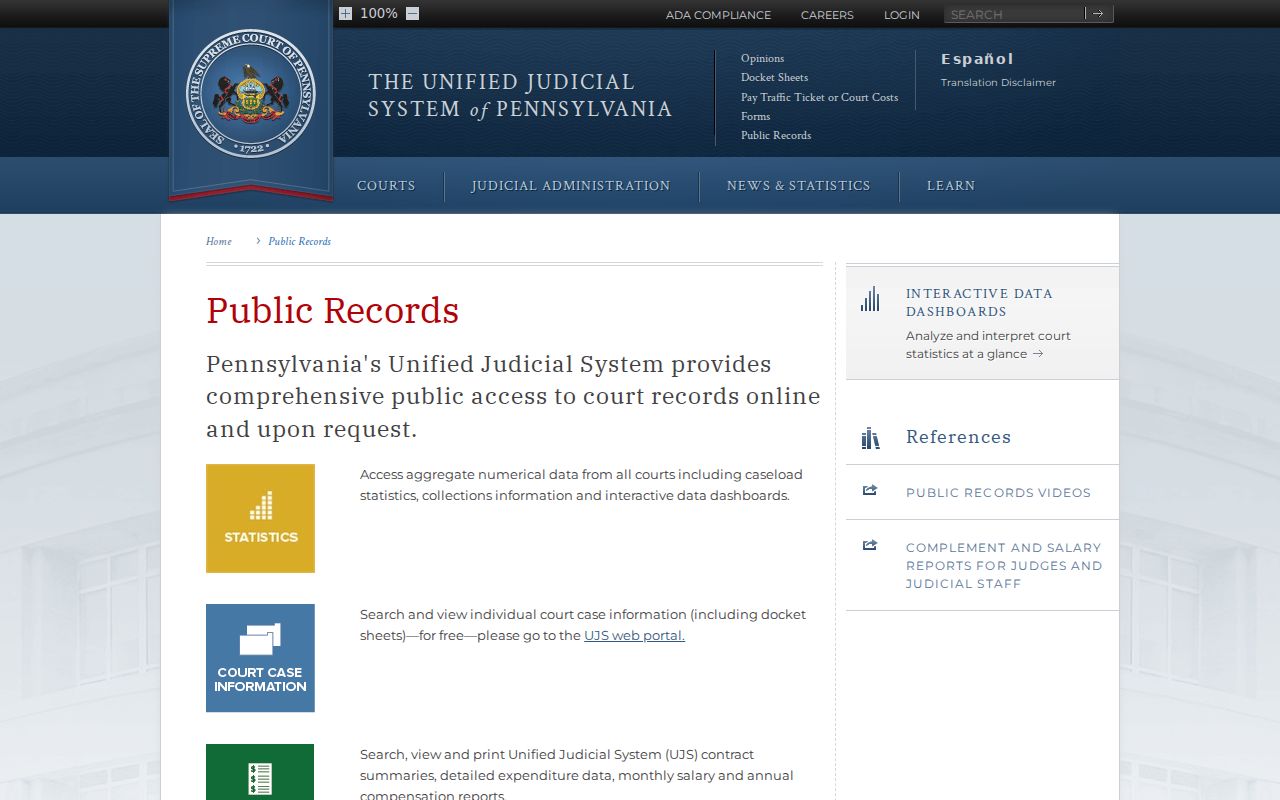
The judiciary route matters when the requested item is a court record rather than an executive-branch county document.
Public access remains subject to sealing, limited access, expungement, confidentiality, and redaction rules. Sensitive identifiers, victim information, and protected material may be removed. When a docket is public but a document is absent online, ask the correct clerk whether inspection or a copy is available. State the docket number and exact document. Broad demands are less useful than a focused request for a named order, information, or docket entry.